
The Right to Disconnect 2.0: Managing Mental Fatigue in 2026
Introduction: Why a “Policy” is No Longer Enough
In 2026, the traditional “Right to Disconnect” policy, the kind that lived in a dusty PDF on an HR portal, is officially dead. The Irish regulatory landscape, guided by the evolving Health and Safety Authority (HSA) standards, has moved past the era of mere suggestion. We have entered the age of Right to Disconnect 2.0.
The challenge is no longer about telling employees to “put their phones away.” In a world saturated with Agentic AI systems that think, act, and communicate on our behalf, the boundary between work and life has become porous. We see the fallout every day: high-pressure sectors like finance, med-tech, and professional services are grappling with a workforce that is technically “offline” but mentally tethered to a relentless digital stream.
To survive 2026, Irish firms must stop relying on employee willpower and start relying on Active Work Design. We aren’t just protecting time; we are protecting the structural integrity of the human mind.
1. The High-Pressure Challenge: Navigating the “Invisible Load”
The modern workplace has birthed a new hazard: the Invisible Load. This isn’t just a heavy to-do list; it is the persistent mental background processing required to manage an unending stream of AI-generated summaries, “urgent” notifications, and the psychological weight of perceived availability.
The Paradox of Agentic AI
While AI has automated the “grunt work,” it has paradoxically increased the intensity of human labour. Humans in 2026 act as the critical validation layer for autonomous systems. We are the ethical oversight. This means that while we may be doing fewer tasks, the tasks we do perform require a higher level of “neurological bandwidth.”
When digital pings constantly fragment an employee, they enter a state of Continuous Partial Attention. This fragmenting of focus is a primary driver of mental saturation. From an EHS perspective, this isn’t just a burnout risk—it’s a safety risk. A saturated mind makes poor decisions, misses ethical nuances, and ultimately leads to systemic failure.
2. Practical Work Design: Building the “Digital Fence”
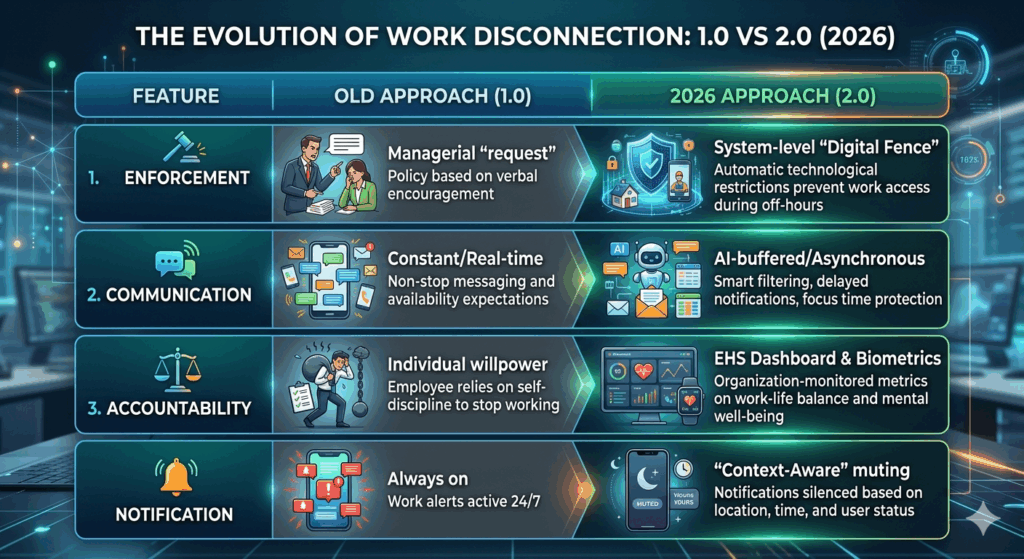
The 2026 approach relies on Smart Systems to do the heavy lifting. We have moved from “suggested disconnection” to Enforced Structural Disconnection. This is the “Digital Fence”—a technological and cultural boundary that protects the worker’s mental space by default.
Smart-Schedules & Asynchronous Balance
Leading Irish firms are now utilizing AI tools to manage what we call “Digital Debt” (the backlog of unread, non-urgent communications).
-
Automated Communication Buffering: Systems now automatically hold non-urgent messages in a “holding pen,” releasing them only during the recipient’s active working hours.
-
Synchronous Standards: Organizations must explicitly define what constitutes a “Synchronous Event” (real-time) versus an “Asynchronous Task” (delayed). This removes the “permanent alertness” state that plagued the early 2020s.
4. The eazySafe Edge: Empowering Personal Boundary Management
At EazySafe, we believe that while systems provide the framework, employees must be empowered to manage their own digital habits. Our 2026 digital induction platform includes specific modules designed to build this “Disconnection Competency.”
-
Cognitive Load Management: We provide verifiable training that teaches employees how to audit their own digital habits and identify early signs of mental fatigue.
-
Managerial Training: We train supervisors to dismantle the “hero culture” that rewards staying online late, emphasising that a rested team is a safer team.
-
Setting the Standard from Day 1: Our digital inductions ensure every new hire understands the company’s “Right to Disconnect” protocols before they even start their first shift.
🛠️ 2026 Action Plan: Moving Beyond the Policy
To move your organisation into the “Right to Disconnect 2.0” era, follow this practical checklist:
-
Update the Risk Register: Explicitly list “Digital Saturation” as a hazard with specific technical control measures.
-
Establish “Digital Blackouts”: Implement technical barriers that disable internal server communication between 7:00 PM and 7:00 AM for non-emergency staff.
-
Monitor Correlation: Audit the link between overtime spikes and near-miss reports in your high-pressure zones.
-
Verify Contact-Free Leave: Ensure that your digital systems facilitate a 100% contact-free period during annual leave, managed by AI triage.
Disconnection as a Strategic Asset
In 2026, the most successful Irish businesses are those that treat mental energy as a finite, precious resource. The Right to Disconnect 2.0 isn’t about working less; it is about working with a refreshed, sharp, and safe mind.
By moving beyond the static policy and into active work design, you are building a resilient organisation that can handle the pressures of the modern world without breaking its people. Safety starts with a rested mind. Is your organisation ready to switch off to stay safe?

Discover our Safety Training Platform
Train your employees anytime, anywhere with our environmental, health, safety and wellness training platform.
TAILORED TRAINING
Discover our safety training courses and ehs onboardings, which can be customised and offered in several languages.
SAFETY MANAGEMENT
Ensure the distribution of your safety policy by training your permanent, temporary or seasonal staff.
GLOBAL MONITORING
Simplify the management of your safety policy thanks to the numerous dashboards and training reports.