
ESG Operationalisation: Why Safety Is
The “S” Your Investors are watching
The Maturation of ESG in 2026
For the past few years, corporate sustainability conversations have been heavily dominated by the “E” (Environmental) carbon footprints, renewable energy targets, and net-zero roadmaps. However, as we move through 2026, the global investment community has shifted its lens. Environmental metrics have become highly standardised, meaning companies can no longer differentiate themselves on green initiatives alone.
Instead, institutional investors and private equity firms are looking directly at the “S” (Social) pillar of ESG. More specifically, they are focusing on how organisations manage their most volatile risk asset: human capital.
Workplace health and safety is no longer viewed merely as an operational line item or a local compliance obligation. In 2026, it is recognised as a direct proxy for corporate governance. Investors have realised that a company that cannot keep its workforce safe is fundamentally unmanageable, volatile, and a high-risk investment.
The 2026 Investor Focus: Beyond the Ticker to the Shop Floor
The modern investor doesn’t just look at financial spreadsheets; they audit the operational reality of the shop floor. In the Irish and European markets, regulatory frameworks like the Corporate Sustainability Reporting Directive (CSRD) have forced businesses to provide granular, verifiable data regarding their labour practices and safety cultures.
Investors are using safety data to evaluate two critical business elements:
Operational Resilience
A high rate of near-misses, dangerous occurrences, or Lost Time Injuries (LTIs) is a trailing indicator of operational friction. It signals poorly maintained machinery, inadequate training, or systemic pressure that forces workers to take dangerous shortcuts. For an investor, this translates to supply chain vulnerability, unpredictable downtime, and eventual asset degradation.
Corporate Governance (The G-Link)
There is a direct correlation between weak safety cultures and poor financial oversight. If an executive board treats workplace safety as a minor bureaucratic exercise rather than a strategic priority, they are likely taking uncalculated risks in other areas of the business, such as data security, financial compliance, or supply chain ethics.
Operationalising the “S”: Moving from Lagging to Leading Indicators
The biggest mistake organisations make when preparing ESG reports is relying entirely on lagging indicators. Reporting that you had “zero fatalities” or a “low injury rate” last year is no longer enough to satisfy top-tier funds in 2026. Investors are hyper-aware that lagging metrics can easily be manipulated by under-reporting or pure luck.
To truly operationalise the “S” pillar, EHS managers must showcase leading indicators and proactive metrics that prove the organisation is actively preventing harm rather than just reacting to it.
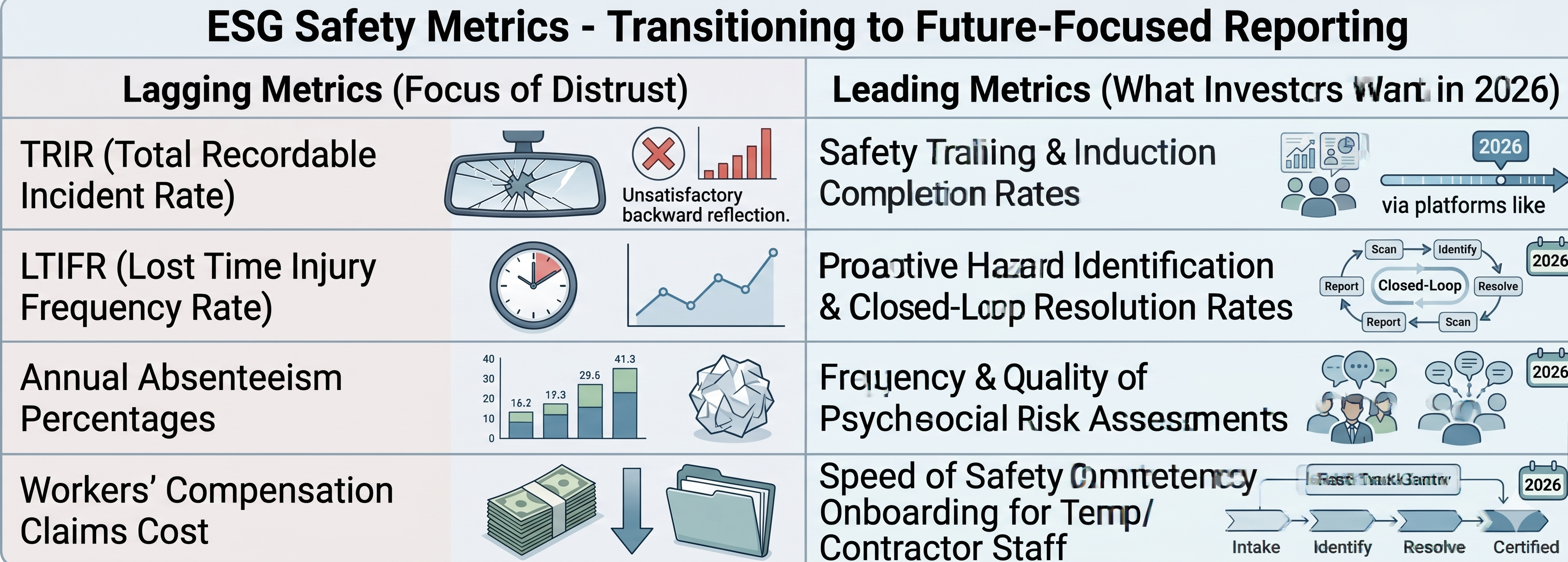
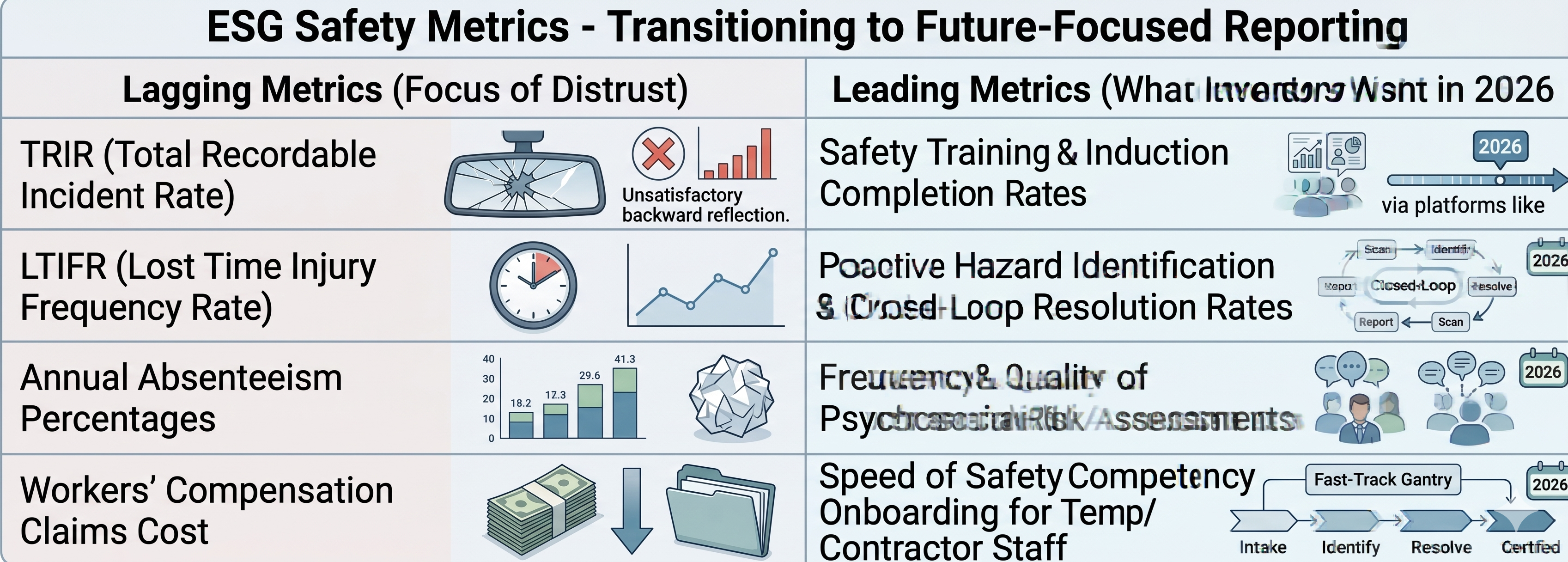
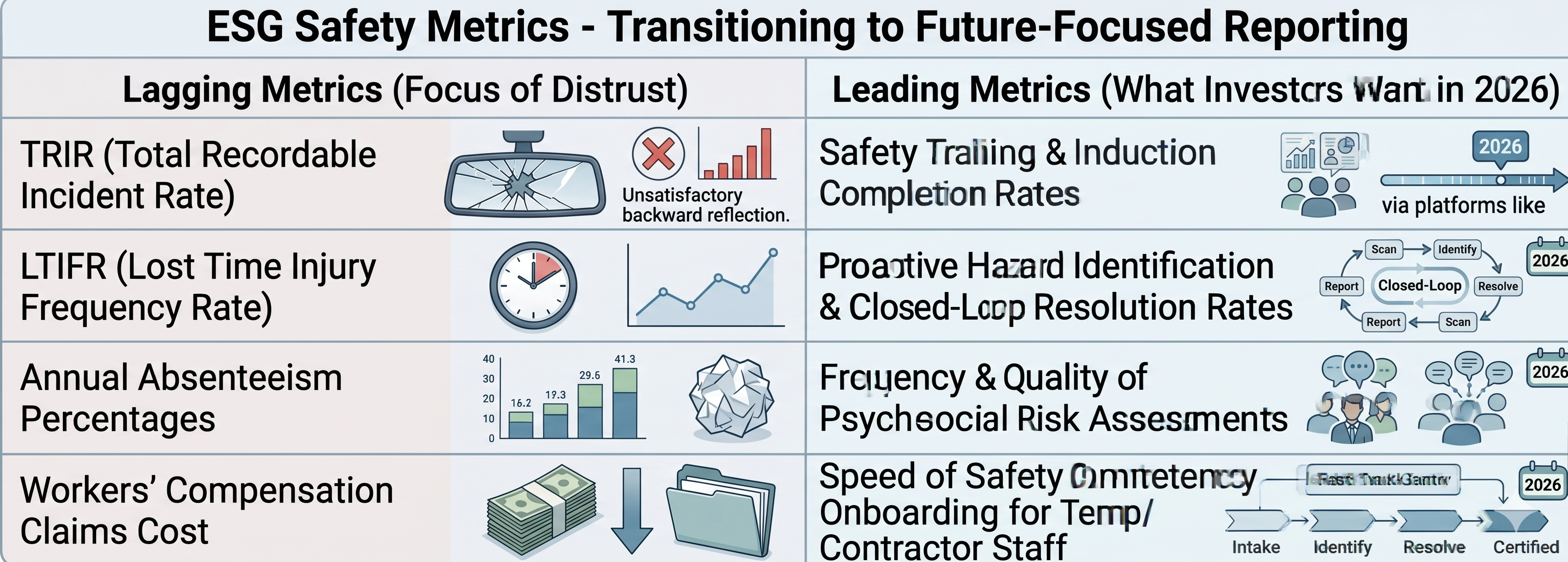
| Lagging Metrics (What Investors Distrust Alone) | Leading Metrics (What Investors Want to See in 2026) |
| Total Recordable Incident Rate (TRIR) | Safety Training and Induction Completion Rates (via platforms like eazySafe) |
| Lost Time Injury Frequency Rate (LTIFR) | Proactive Hazard Identification & Closed-Loop Resolution Rates |
| Annual Absenteeism Percentages | Frequency and Quality of Psychosocial Risk Assessments |
| Workers’ Compensation Claims Cost | Speed of Safety Competency Onboarding for Temporary/Contractor Staff |
🔎 The Auditor’s Strategic View: Safety as an Equity Driver
When we evaluate a business today, a high safety training deficit or a fragmented, paper-based compliance system is treated as a hidden debt. It tells the investor that the company has been underfunding its human infrastructure to inflate short-term margins. Conversely, a business that can show 100% digital, timestamped training compliance across its entire footprint instantly commands a premium. In 2026, safety excellence is an absolute driver of valuation.
The Financial Impact: Insurance, Capital, and Talent
Failing to operationalise safety within your ESG strategy has tangible financial consequences in today’s market.
Cost of Capital
Many European banks have tied interest rates on corporate loans to sustainability performance targets (SPTs). A spike in workplace safety incidents or a failure to document robust health and safety inductions can trigger a breach of these targets, immediately raising the company’s borrowing costs.
Insurance Premium Volatility
The insurance landscape in Ireland has adapted sharply to data analytics. Underwriters are rewarding organisations that utilise digital management systems with lower premiums, while penalising those relying on legacy, unverified safety programs.
The Talent Premium
The “S” in ESG also dictates a company’s ability to attract top-tier talent. In a highly competitive labour market, workers, particularly younger generations, actively research an employer’s safety reputation and wellness culture before accepting roles. A strong safety record minimises turnover, lowering recruitment costs and protecting institutional knowledge.
The EazySafe Edge: Delivering the Audit Trail Investors Trust
The greatest challenge in ESG operationalisation is data integrity. You cannot put vague assertions or unverified metrics into a sustainability report without risking accusations of corporate “social washing.”
This is where EazySafe changes the game for corporate leaders. Our digital platform provides the exact raw, immutable data required to satisfy institutional investors and ESG auditors.
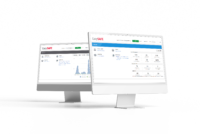
- Verifiable Transparency: wazySafe provides clean, cloud-based dashboards showing exact completion rates for safety inductions, environmental awareness modules, and specialised risk training.
- Contractor Compliance: Investors are highly critical of companies that maintain good safety records for internal staff but outsource high-risk work to unprotected contractors. EazySafe centralises contractor inductions, proving that everyone stepping on your site meets the same high safety standard.
- Scalable Standardisation: For multi-site or multinational organisations, eazySafe standardises the safety training footprint, allowing the executive board to present unified, audit-ready ESG data to stakeholders.
2026 ESG Safety Action Plan: A Guide for EHS Managers
To align your safety operations with the expectations of modern investors, integrate these five steps into your department’s workflow:
- Bridge the Gap with Finance: Meet with your organisation’s sustainability or finance team. Ensure your leading safety metrics are integrated directly into the corporate ESG reporting framework.
- Digitise the Compliance Trail: Eliminate paper sign-in sheets and localised Excel trackers. Move all induction and core safety training to a centralised digital hub like EazySafe.
- Include Supply Chain/Contractors: Expand your risk assessment and onboarding tracking to cover 100% of temporary workers and third-party contractors.
- Monitor Safety Competency Speed: Track how quickly a new hire achieves full safety competency, showcasing your ability to de-risk human onboarding.
- Report Proactive Engagement: Document the number of safety observations, safety walks, and digital toolbox talks completed by line management to prove an active safety culture.
Safety is Your Best Social Asset
Operationalising ESG is not about inventing new metrics or adding bureaucratic layers to your business. It is about taking the vital work you are already doing on the ground, keeping people safe, healthy, and alert and translating it into the structured data that the financial world understands.
In 2026, safety is the most honest, transparent indicator of how much a company values its workforce. By leveraging advanced digital tools like EazySafe to capture and showcase that commitment, you protect your workers, satisfy your investors, and future-proof your business legacy.
When it comes to the sustainability of your organisation, remember: if it isn’t safe, it isn’t sustainable.

Discover our Safety Training Platform
Train your employees anytime, anywhere with our environmental, health, safety and wellness training platform.
TAILORED TRAINING
Discover our safety training courses and ehs onboardings, which can be customised and offered in several languages.
SAFETY MANAGEMENT
Ensure the distribution of your safety policy by training your permanent, temporary or seasonal staff.
GLOBAL MONITORING
Simplify the management of your safety policy thanks to the numerous dashboards and training reports.